Geese
The Darling Buds of MayGeese recur as noisy, free-moving inhabitants of the Larkins’ domestic world and, at the same time, as animals destined for the table. They cross the boundary between yard and house without ceremony: their voices interrupt conversation, their bodies brush against a visitor in the dark, and, after being killed, they reappear as the centrepiece of a feast. This movement from living presence to food gives them a distinctive role in the family’s comic challenge to ordinary domestic decorum.
Presence in the Larkin Household
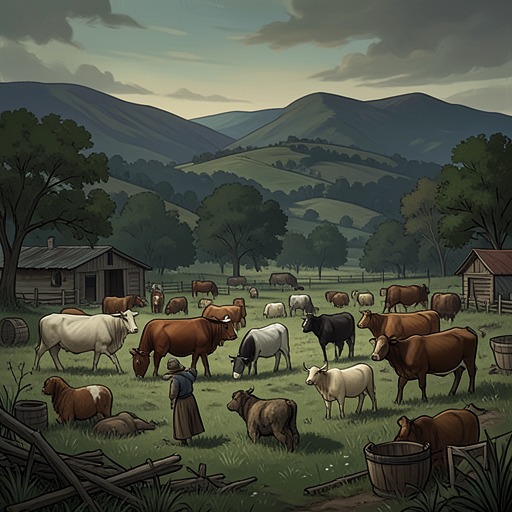
During Cedric Charlton’s first visit, Pop’s ringing laughter is answered from beyond the stable by the geese. Three swaggering grey-white birds emerge from a barricade of nettles, followed by a dozen half-sleepy guinea fowl. The scene presents the farm’s animals not as distant livestock but as part of the visitors’ welcome: Pop immediately mentions the household’s habit of killing a goose, turkey, or chickens for the weekend, then asks whether Charlton likes guinea fowl.
The geese also enter the house during the family’s evening meal. In the television’s flickering light, Charlton tries to speak over jazz, television voices, family chatter, and the animals hawking at the kitchen door. The domestic scene’s crowded soundscape and dim, shifting illumination make the farm’s separation between human gathering and animal life seem especially porous. Ma feeds scraps to kittens on her lap, while the geese press at the entrance, waiting within reach of the same meal.
Comic Intrusion and Misrecognition
That boundary-crossing becomes a moment of personal embarrassment when the television is switched off and the room falls into half-darkness. Charlton feels something smooth and sinuous brush his calf and, for a shimmering instant, believes Mariette’s leg is curling around his. The apparent intimacy turns out to be a goose under the table; Ma is feeding the birds scraps of fish, cold chips, and crumbled iced buns. The geese are not merely background noise: their unannounced contact redirects Charlton’s attention and interrupts the formal purpose of his visit.
The same gag returns when Mariette goes into the kitchen to prepare eggs. Pop calls after her about the large brown ones, and the geese follow, brushing past Charlton’s legs again. His moment of unnerving ecstasy is renewed by the same innocent animal movement he had already mistaken for human touch. Repetition converts the first shock into a running comic motif: the visitor’s romantic anticipation is repeatedly displaced by the ordinary, bodily presence of farm life.
The Farm’s Rhythms and Abundance
The geese belong to a household economy in which eating, keeping animals, and making do are closely connected. Pop treats their slaughter as a regular weekend practice, mentioned alongside turkeys and chickens rather than as an exceptional occasion. Later, after Mariette’s encounter with Charlton, Pop returns to the kitchen having wrung the necks of three fat geese and pours himself a much-needed glass of beer. The matter-of-fact transition from courtship elsewhere to killing and kitchen work at home binds the farm’s emotional and practical lives together without making either seem out of place.
A quiet afternoon offers a contrasting view of the same rural setting. Charlton has temporarily abandoned his attempt to estimate the household’s income; a goose brushes his legs, a dog barks in the yard, and turkeys answer in a bubbling chorus. A cuckoo calls in broken, throaty tones, after which the afternoon settles into a breathless moment of quiet. The geese remain part of this layered soundscape, their casual proximity to Charlton set against the brief calm of the countryside.
From Living Birds to Feast
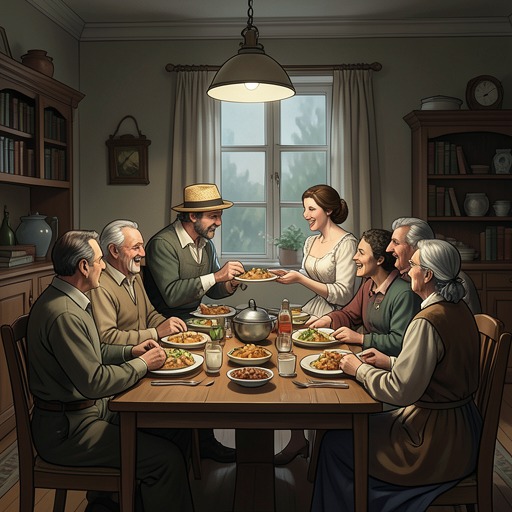
The recurrence reaches its fullest transformation at the meal under the walnut tree. Half an hour after the Brigadier refuses another drink, two of the three geese are laid side by side in a large oval blue dish, browned and glazed with running gravy. They share the table with peas, new potatoes, baked onions, asparagus, roast potatoes, Yorkshire pudding, broad beans, apple sauce, and gravy. Pop carves with dexterity, and the birds resemble laden brown galleons floating in a glistening sea of gravy.
The meal makes visible what Pop had earlier described as ordinary practice: the geese heard around the house and seen beneath the table become food offered to guests. The Brigadier, who might once have judged such a display indecorous, now watches with restrained bewilderment rather than voicing that objection. The birds’ passage from nettle-bordered yard to the blue meat dish condenses the household’s abundance and its disregard for formal restraint. Their recurring presence links comic disturbance, farm work, and hospitality in a single, unmistakably Larkin pattern.